
Extension planes
Everything you can extend in Noeta goes through one mechanism: a named surface that a plugin contributes to, or that you hand-wire through an Options field. There are sixteen surfaces, grouped into three planes by what a contribution means — whether it changes who the agent is, how it is mounted onto a host, or what resources the host supplies.
This page covers the planes, the loader that fills them, and how Noeta's own capabilities ride the same path as yours.
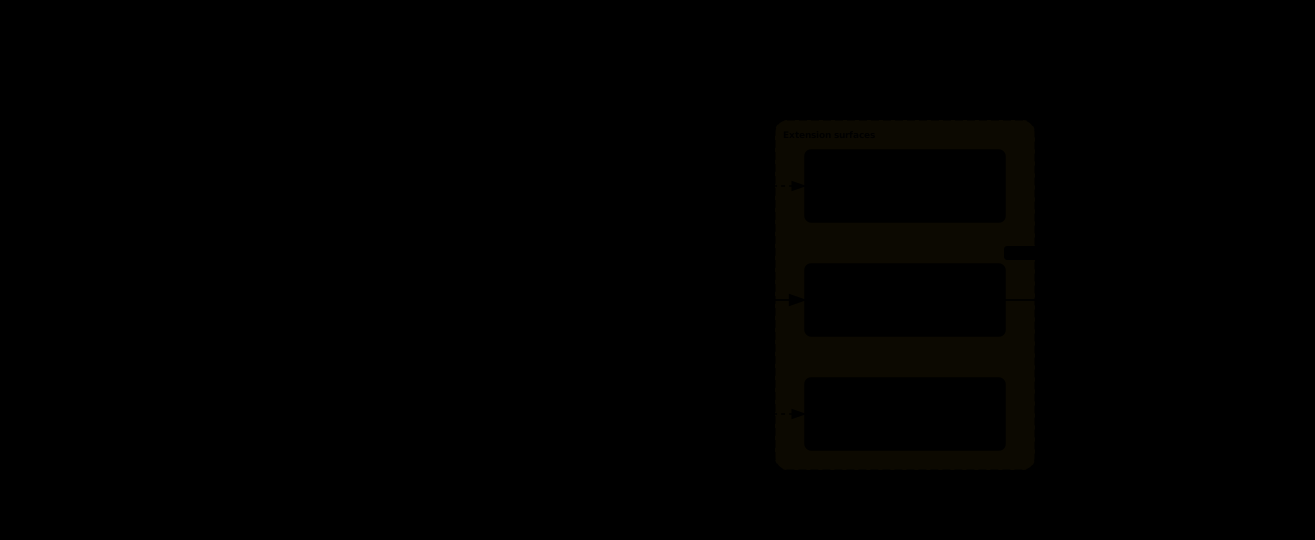
The cut that everything else follows
Before the surfaces, one distinction runs through the whole design: identity versus wiring.
- Identity decides how the agent thinks — system prompt, tool set, skills, activated plugins, the decision policy. It enters the durable recording and is reproduced verbatim on fold.
- Wiring only mounts the agent onto a host — the provider instance, the working directory, an approval callback, observers, storage. It is excluded from identity (
compare=False), so swapping it never perturbs a recording.
The cut is mandatory, not stylistic: recordings must be reproducible. Mix the two and a replay fails to line up because someone changed a working directory. It is also why swapping LLM vendors is free — see Swap providers.
The three planes
| Plane | Surfaces | Scope | In agent identity? |
|---|---|---|---|
| Identity | tool, agent, content_kind, prompt_fragment, policy, control_tool | per-agent | yes |
| Wiring | guard, observer, provider, reminder_provider, reminder, tool_result_transform, session_pack | process, host-wired, or per-agent | no |
| Host | mcp_server, skills, sandbox_provider | host-wired | no |
Two details in that table earn their place.
guard and observer are process-wide, and deliberately not opt-out. Once a plugin carrying them is loaded, they are in force for every agent in the process, whether or not that agent activated it. Governance is operator authority: an agent author must not be able to skip compliance interception or audit by omitting a name from a tuple. Everything else on the wiring plane is per-agent or host-wired.
The wiring plane has exactly two process-wide channels. A plugin that tries to register a third process-scoped surface is refused at construction rather than quietly filed under one of the two.
Each surface is fully described by a SurfaceSpec: its plane, activation scope, validator, collision key, ordering, and — for identity surfaces — which activation channel a contribution feeds. Full per-surface detail is in the plugin surfaces reference.
The loader is surface-agnostic
load_plugins(...) reads static manifests into a PluginSet without importing any plugin code. A contribution's ref is a string; it resolves only at the client-build boundary. That is what makes a plugin listable, auditable, and collision-checkable before any of it runs.
The loader consults exactly one SurfaceRegistry — a name → SurfaceSpec map — and nothing else. Adding a surface is registering a SurfaceSpec, never editing the loader. A host adds its own by taking standard_registry().copy(), registering its surface, and passing that registry to load_plugins; a contribution on it is validated and collision-checked by the same pipeline and then handed to the host, never entering agent identity.
Contributions merge deterministically, ordered by (plugin, name) or by an integer priority where the surface declares one. A collision names both sides and fails — there is no override, and no last-writer-wins.
Activation is identity
Loading makes a plugin available in the process. Activation decides which agents use it: Options.plugins and AgentDefinition.plugins, tuples of names that fold into the single AgentSpec.plugins identity tuple.
Feature gating then reads that tuple through agent_activates(agent, plugin) — membership is the capability. There is no second registry of flags, no runtime restriction bolted on afterwards.
An unrecognised name fails compilation loudly, so a typo can never silently turn a capability off. DEFAULT_PLUGINS = ("fs", "web") is the default and is identity-inert, which is why a bare Options() compiles byte-identically to what it always did.
Because activation is identity, it turns over the KV-cache prefix. Plan an agent's plugin set the way you plan its tool set — not per turn.
How a built-in is laid out
Noeta's own capabilities are plugins, with no privileged path. One directory per built-in under packages/noeta-sdk/noeta/builtins/<name>/:
noeta/builtins/memory/
├── __init__.py        # MANIFEST — inert data, zero execution
└── impl/              # the code the manifest's refs point at
__init__.py declares a PluginManifest and nothing else, so importing the band imports zero implementation modules. The manifest's ref strings name sibling modules under impl/, resolved by the loader's dynamic import at client build. .importlinter forbids any static import of noeta.builtins from anywhere in the tree.
Adding a first-party capability is therefore adding a directory — the same act as shipping a third-party plugin, minus the packaging. See Write a plugin for the authoring side.
The agent layer
An agent's identity is an AgentSpec: a name plus the identity-side configuration — instructions, policy ref, tools, the plugins activation tuple, the spawnable roster. It is compiled from Options and collected in a registry. The layer sits low in the runtime and depends only on the protocol layer, because an agent is a class of task, not a network surface.
Four official agents ship, each with a deliberately trimmed surface:
| Agent | Role | Tool surface | Delegates? |
|---|---|---|---|
main | the conversational controller | full built-ins + TodoWrite / AskUserQuestion / skill_invocation / memory / mcp | yes |
general-purpose | a self-contained worker | read / write / edit + shell + web | no — a leaf |
explore | a read-only scout | read-only tools | no |
plan | a read-only planner | read-only tools | no — produces a plan |
Two more identities exist outside that set: web, the browser subagent that only sandbox_browser_options() puts on main's roster, and __consolidation__, the internal memory curator a host registers with with_consolidation_agent().
Delegation takes two shapes. Single: the parent spawns one subtask, suspends, and wakes when it completes. Fan-out: the parent spawns a group that runs concurrently on a bounded in-process pool (min(8, CPU count), overridable with NOETA_MAX_SUBTASK_CONCURRENCY), and the results return together, each paired to its original tool call. Every subtask is a full event-sourced task with its own log and fold, related to its parent only by parent_task_id.
What stays locked
Not everything is a surface, and the exceptions are principled:
- The Engine main loop. Its control flow only routes Decisions; changing what the agent decides is what the
policysurface is for. - The Dispatcher / Worker / Lease protocol. A host tunes concurrency and lease timing through
HostConfigand nothing more — the single-writer fence depends on it. ThreeSegmentComposer. Replacing the composer wholesale is not offered, because stable-prefix KV-cache reproducibility is a protocol-level hard constraint. Its open hooks are registry-only and append-only: aContentKindSpec(a semi-stable resident) or a compose-timereminder(the dynamic-suffix tail). Neither touches the stable prefix.- Storage backends. Wired through
HostConfig, never a plugin surface, and never part ofAgentSpecidentity. The public doorway isnoeta.sdk.storage.
Where to go next
- Packages and boundaries — the import rules that keep the builtins band reachable only through the loader
- Write a plugin — the authoring walkthrough
- Plugin surfaces reference — all sixteen, one section each
- Plugin manifest reference — the manifest shape, loading sources, and versioning