
Plugins
A plugin is a package — or a single .py file — that carries a static manifest listing what it contributes to Noeta. Loading a plugin reads those manifests; it does not run any plugin code. An agent then activates the plugins it wants. That two-step split is the whole idea: a host decides what is available, an agent decides what it uses.
Noeta ships its own capabilities the same way. The 10 default tools, the default guards, and the three compose-time reminders are all built-in plugins, resolved through the same loader as anything you write. (Provider adapters ship in the SDK too, but a host constructs them directly from noeta.sdk.providers — the providers built-in contributes nothing to a surface.)
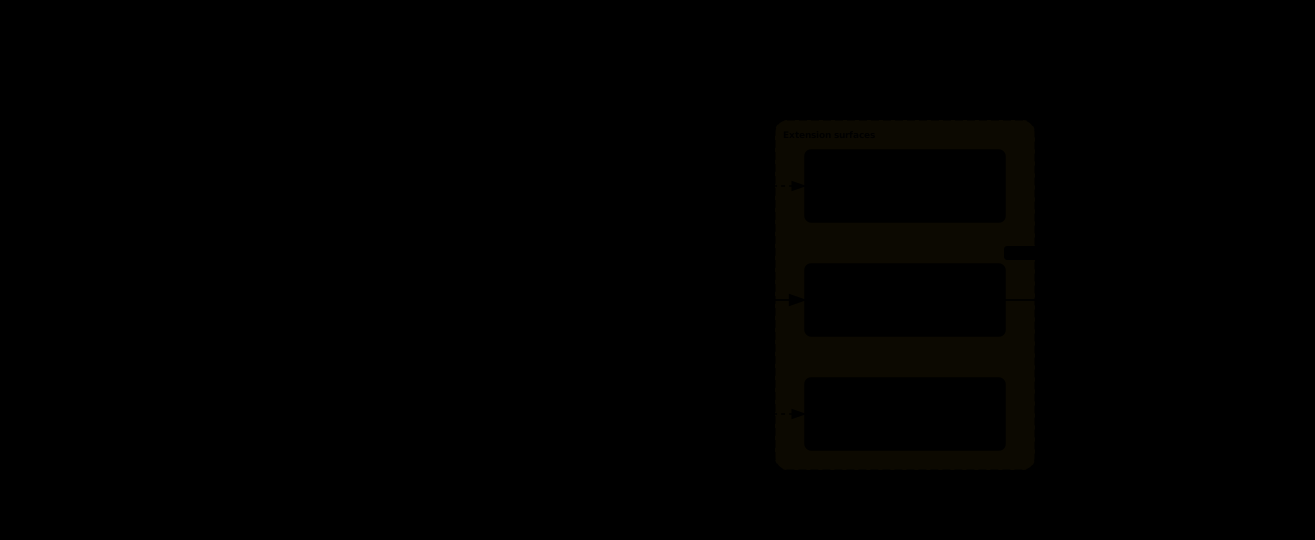
The three planes
Every contribution lands on one of sixteen surfaces, and each surface sits on one of three planes. The plane decides where the contribution has effect.
| Plane | Surfaces | Effect |
|---|---|---|
| identity | tool, agent, content_kind, prompt_fragment, policy, control_tool | enters the recorded AgentSpec; follows per-agent activation |
| wiring | guard, observer, provider, reminder_provider, reminder, tool_result_transform, session_pack | behaviour, not identity. guard and observer are process-wide once loaded — governance is operator authority, not an agent-author opt-in |
| host | mcp_server, skills, sandbox_provider | the host selects and binds them; never per-agent |
Full contract for each surface, with a worked example: Plugin surfaces.
A minimal plugin
Two files. The manifest declares the contribution; the module holds the code.
# pyproject.toml
[tool.noeta]
name = "house-style"
requires-noeta = ">=0.4"

[[tool.noeta.contributions]]
surface = "prompt_fragment"
name    = "house-style"
text    = "Answer in at most three sentences."

[[tool.noeta.contributions]]
surface = "tool"
ref     = "house_style.tools:LintTool"    # module:attr import string
Load it, then activate it on an agent:
from noeta.sdk import Client, DEFAULT_PLUGINS, Options, load_plugins

pset = load_plugins(entry_points=True)      # built-ins + installed plugins
print(pset.names())
# → ('app', 'ask_user_question', …, 'house-style', …)

options = Options(
    system_prompt="You are a coding agent.",
    plugins=DEFAULT_PLUGINS + ("house-style",),
)
client = Client(options, provider=my_provider, workspace_dir=".", plugins=pset)
Manifest shape, the loader's five sources, the trust gate and version pinning: Plugin manifest.
Load, then activate
| Step | Where | What it decides |
|---|---|---|
| Load | load_plugins(...) -> PluginSet, host level | which plugin code is available in this process |
| Activate | Options.plugins / AgentDefinition.plugins, agent level | which loaded plugins this agent uses |
Client(options, plugins=<PluginSet>) binds the two. An activation name that is not in the loaded set fails the build — loudly, at startup, never mid-turn. Activation enters AgentSpec identity, so an agent that gains a plugin is a different agent in the record. The full activation vocabulary is in Options.
A PluginSet is listable and collision-checkable without executing plugin code: .contributions() and .merged() read only the static manifests, and .resolve() is the single import boundary, called once at client build.
for plugin_name, contribution in pset.contributions("tool"):
    print(plugin_name, contribution.name)   # no plugin body imported
# → fs read
# → fs glob
# → …
Where to go next
| Page | Covers |
|---|---|
| Plugin manifest | the [tool.noeta] tables, PluginBuilder, load_plugins, the trust store, requires-noeta, packaging |
| Plugin surfaces | all sixteen surfaces, one section each, with the built-in that demonstrates it |
| Write a plugin | the task-oriented guide |
| Extension planes | why the planes are drawn where they are |