
Packages and boundaries
Noeta ships as two libraries that share one import namespace. This page covers how they are cut, why the cut is where it is, and the import rules that keep it honest — including the one rule that makes provider neutrality structural rather than a promise.
You never need this to use the SDK. You need it when you are extending Noeta, packaging it, or auditing what the kernel can reach.
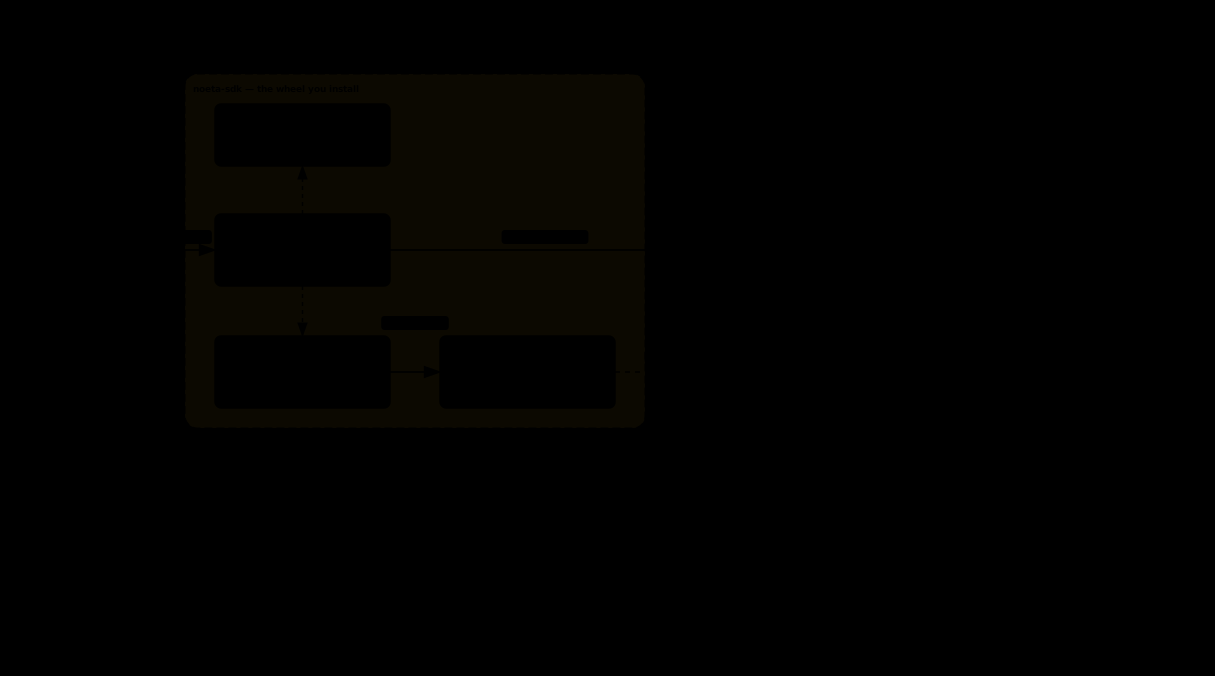
A host drives the SDK in-process; the SDK forwards into the runtime's engine, materials, and storage. Built-ins reach the kernel only through the loader.
Two libraries
| Package | Role | Depends on |
|---|---|---|
noeta-runtime | The pure kernel — everything needed to host one agent in-process, with no capability implementation of its own. | stdlib only |
noeta-sdk | The thin client and the only thing users import — plus noeta.builtins, where every official capability actually lives. | noeta-runtime, httpx, psycopg |
The runtime's top-level modules are protocols (the typed boundary, importing nothing else in-project), core (Engine, fold, snapshot), the kernel services runtime / storage / observers / read_models, the materials band context / policies / tools, the injection-only execution builder, the agent identity layer, and testing.
The SDK adds four: client (the assembly boundary), sdk (the public façade), presets (the official agents), and builtins (the capability catalogue).
Users install noeta-sdk and import only noeta.sdk. noeta-runtime arrives as a transitive dependency they never touch. On PyPI the bare noeta name belongs to an unrelated project, which is why both dists carry a suffix.
One namespace, two wheels
Both packages contribute subpackages to one shared PEP 420 namespace package, noeta. There is no noeta/__init__.py in either wheel; Python merges the two trees at import time.
The consequence is worth stating plainly: noeta.core, noeta.context, noeta.builtins are stable import paths regardless of which wheel ships them. Moving a module across the distribution boundary changes packaging, not any import statement — and every contract below reruns unchanged.
The import rules
The dependency direction is not left to discipline. .importlinter runs in CI and fails the build on a violation. Ten contracts hold the topology; these are the load-bearing ones.
The layer stack (layers), top to bottom:
noeta.sdk
noeta.builtins | noeta.presets
noeta.client
noeta.execution
noeta.context | noeta.policies | noeta.tools
noeta.runtime | noeta.storage | noeta.observers | noeta.read_models
noeta.agent.registry
noeta.agent.spec
noeta.core
noeta.protocols
A module may import downward, never upward.
noeta.protocols imports nothing in-project (protocols-isolation). It is the typed boundary every other layer speaks, so it cannot depend on any of them.
noeta.core may import only noeta.protocols (core-uses-only-protocols), with one documented exception: the Engine lazily imports noeta.runtime.tool.ToolRuntime when a caller did not wire one, and the contract whitelists that single edge by name rather than opening the layer.
Nothing statically imports noeta.builtins (sdk-core-not-builtins). This is the universal microkernel contract, and the next section is what it buys.
Smaller contracts keep the leaves narrow: noeta.observers and noeta.read_models see only protocols (plus one whitelisted core.fold edge), noeta.agent.spec / registry see only protocols, the kernel vocabulary sinks noeta.runtime.governance / mcp see only protocols, and production code talks to the storage Protocols rather than the in-memory adapters.
The kernel carries no capability
Every official capability — the fs and web tool packs, the provider adapters, the default guards, memory, browser, MCP, sandbox backends, skills, the ReAct policy, the durable storage backends — is a built-in plugin under packages/noeta-sdk/noeta/builtins/<name>/.
Nothing imports that band statically. The only doorway is the plugin loader's dynamic ref resolution, resolved once at client build. Importing noeta.builtins therefore imports zero implementation modules, and .importlinter rejects any static edge that would change that.
Two things follow, and both are structural rather than aspirational:
- Provider neutrality. Every vendor adapter lives in the
providersbuilt-in. The kernel cannot import one, so it cannot grow a vendor assumption. See Provider neutrality. - First-party capabilities are not privileged. Noeta's own built-ins ride the identical loader, validation, and merge path as a third-party plugin, so the extension path is exercised by every default agent on every run.
The catalogue
Eighteen built-ins ship in noeta-sdk:
| Group | Built-ins | Fills |
|---|---|---|
| Tool packs | fs, web, memory, browser, app, workspace | tool, session_pack, prompt_fragment, reminder_provider |
| Control tools | TodoWrite, AskUserQuestion, delegation, react | control_tool |
| Context | skills, reminders | session_pack, reminder |
| Governance | governance | guard, observer |
| Agents | presets | agent |
| Declaration-only | providers, mcp, storage, sandbox | (host-wired) |
The last row is the interesting one. providers, mcp, and storage carry zero contributions: an LLM adapter, an MCP connector, and a storage backend are all host wiring, not agent identity, so they are reached through noeta.sdk.providers / noeta.sdk.storage and the loader's dynamic doorway rather than merged onto a surface. They live in the catalogue anyway, because that is where implementation code belongs. (sandbox contributes one sandbox_provider on the host plane.)
react refuses to be disabled: it supplies the default decision policy that every compiled agent's identity pins, so the brain is replaceable through the policy surface, not removable.
Distribution
Because ground truth is a fold over a durable log, distribution is mostly a scheduling problem: any process that can read the store can rebuild any task, and execution assumes nothing about which machine it runs on.
The default shape is single-host — a local SQLite file and a resident worker pool in one process. Reaching multi-host is a storage-adapter swap: point the deployment at Postgres and several host processes share one database, their writes fenced in-transaction. The Engine does not change either way.
Neither wheel speaks HTTP or ships a daemon. A host that wants an API builds it on top of noeta.sdk; examples/reference-host is the smallest such host.
Where to go next
- State and writers — what the single-writer invariant actually protects
- Extension planes — the 16 surfaces the loader fills
- Architecture overview — the top-down tour
- Plugins reference — the manifest format and the loader's sources