
Concepts
These pages explain why Noeta is shaped the way it is. They are background reading rather than instructions — nothing here asks you to run a command. If you would rather see something work first, do the quickstart and come back.
Read them in the order below. Each page assumes only the ones above it, and every page opens with a plain-language summary and a diagram.
Three ideas carry the whole design
Everything else — audit, replay, suspend/resume, provider neutrality — falls out of these three.
1. State is a fold over an event log

Each task owns one append-only stream of events: the goal it was given, each composed context plan, each model response, each tool call and its result, each suspend and wake. There is no task table the engine reads and writes. When something needs the current state, it folds the stream from the beginning and gets it — the state object is a disposable projection, the log is the master copy. Event payloads stay small (capped at 4 KB); anything bigger, such as a full response body or a large tool output, goes to a content-addressed store and the event carries only a reference. Because folding is the only way state comes into being, "what the agent did" and "what the agent is" can never disagree.
→ Event sourcing · Fold & snapshot · State & writers
2. Kill it mid-task, it resumes

A worker takes a lease on a task — a short, heartbeat-renewed exclusive hold — and drives it to the next suspend or terminal state. Every write to the log presents that lease id, so exactly one worker can ever be writing a given task. If the worker dies, its heartbeat stops, the lease expires, and the task returns to the ready queue; the next worker folds the log, seals the interrupted attempt as dead history, and carries on from the last durable point. The same machinery covers deliberate waiting: a task can suspend for a human answer, a timer, or a subtask, costing nothing while it sleeps, and the wake that revives it is durable, single-worker, and delivered exactly once — at-least-once delivery plus idempotent consumption.
→ Wake & resume · Task model · Deploy a worker
3. Two packages, capabilities as plugins
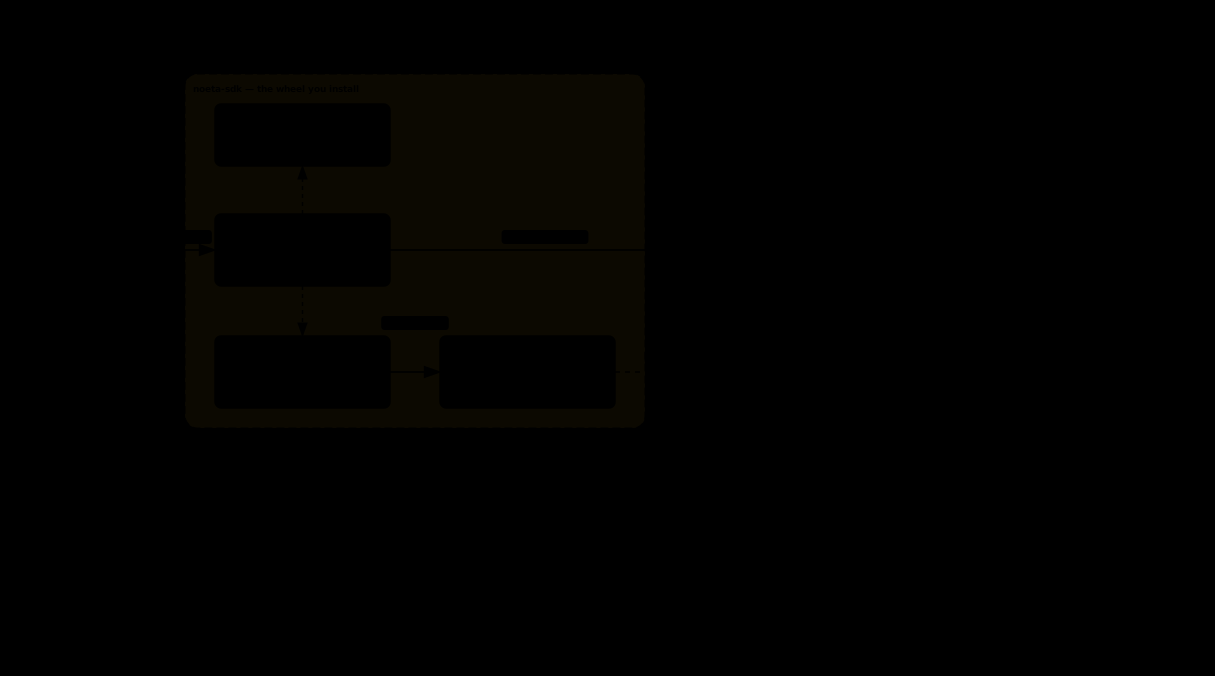
Noeta ships as two libraries sharing one noeta. namespace. noeta-sdk is the only thing you import: query / Client / Options / @tool, the preset agents, and every official capability. noeta-runtime is the pure kernel — engine, fold, snapshot, worker, dispatcher, lease, context composer — and it declares no dependencies at all. The kernel carries no capability of its own: the file tools, web tools, memory, browser, MCP, sandbox, storage backends, and every provider adapter are built-in plugins that reach the kernel only through the loader's dynamic reference resolution, a rule an import linter enforces on every build. That single boundary is why provider neutrality is structural rather than a promise, and why your plugins ride the exact same path Noeta's own do.
→ Architecture overview · Packages & boundaries · Extension planes
Reading order
Event sourcing — Noeta never treats "current state" as the truth. It appends a record of everything that happens to a per-task log and recomputes state from that log. Start here; every other page leans on this one idea.
The Task model — a Task is the only unit of work there is. Conversations, background jobs, and delegated subagents are all Tasks, each with one log, four state slices, and four statuses.
Engine & execution — how a Task actually moves forward: build the model's input, ask what to do next, carry it out, repeat until the Task waits or finishes.
Fold & snapshot — the function that turns a log back into state, why it is deliberately boring, and how snapshots make it fast without ever becoming a second source of truth.
Wake & resume — what happens while a Task is waiting on a person, a timer, a subtask, or an outside system, and how it gets picked back up exactly once even if a machine dies mid-step.
Guard vs Observer — the two ways to hook into a running agent: one can stop an action before it happens, the other can only watch after the fact. There is no third.
Composer & context caching — how Noeta decides what the model sees on each call, and why that layout is arranged around the provider's prompt cache.
Provider neutrality — why no vendor's message format is allowed to become Noeta's internal one, and how that is enforced by an import rule rather than by good intentions.
The short version
A Task is one run of an agent. Everything that happens to it is appended to its EventLog; its state is folded from that log on demand. The Engine advances one Task by one step: compose what the model sees, ask a Policy what to do, record the result. When the Task has to wait, it suspends and its wake condition is held durably until something matches it. Guards can veto actions on the way through; Observers watch the log afterwards. Everything the model sees is assembled fresh each turn by the ContextComposer, and every LLM vendor sits behind an adapter.
Next
- Quickstart — run an agent in about five minutes.
- Architecture overview — the same system from the module and package angle.
- Glossary — every term on these pages, defined in one place.